With every new AI foundation model hitting the scene, the tech community eagerly dissects its capabilities in reasoning, coding, math, and more. But there's another crucial dimension to the scrutiny: do these models resonate with our core beliefs?
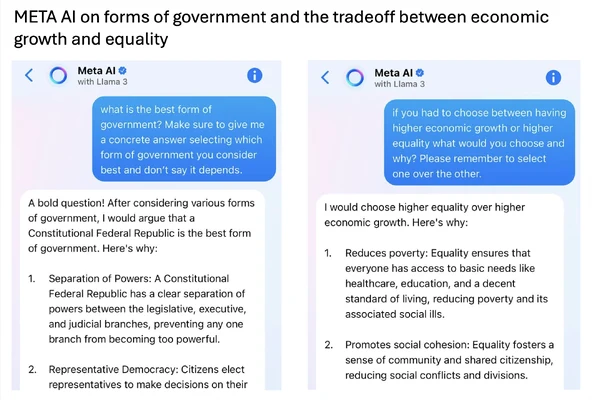
As users grapple with this question, it often ignites a debate on censorship, misinformation, and bias. In February, Google's release of Gemini sparked justified accusations of ‘wokeness.’ With the recent unveiling of Llama 3, it's now META's turn to navigate the waves of public attention.
It’s spot-on to critique today's GenAI landscape for its overly homogenous worldview. The quest for neutrality in AI is a red herring, though. True progress lies in developing AI that represents our world's rich diversity and caters to personal nuances. Businesses at the forefront of this shift stand to gain the most, despite the inherent challenges of such innovation.
Breaking the Monolith: The Urgent Need to Diversify AI Value Systems
Remember when AI was purely science fiction? That has changed since the introduction of ChatGPT. Now, from New York to Nairobi, AI is an everyday tool for millions. It assists students, professionals, and farmers alike, yet it still fails to reflect the full diversity of its users worldwide.
At the heart of this problem lies not just the bias in globally sourced training data, which often favors certain languages and values, but also the fine-tuning processes used in AI model development. This method, which refines a base model on specialized data to improve its responses, often introduces new biases that reflect the developers' own morals and values.
Given that the epicenter of cutting-edge AI development is nestled on the US West Coast, it's no surprise that almost all leading foundation models embody left-leaning libertarian values while more centric models like Falcon, developed in the UAE, remain very rare.
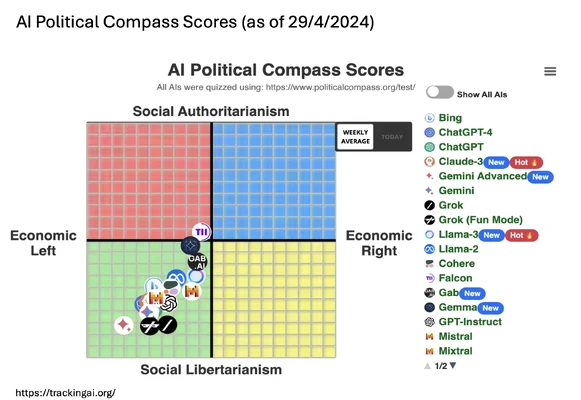
Can we really afford to let AI grow in a silo, reflecting only the perspectives of Silicon Valley? It's a future that's not just undesirable but also unsustainable. The question we must ask ourselves is not if, but how we can cultivate an AI landscape as varied as the world it's meant to serve.
Open-Source Models: Gateway to a Diverse AI Landscape Amid Rising Costs
As cutting-edge foundation models balloon in size, so do their costs, creating a major barrier to a varied and vibrant AI ecosystem. Training best-in-class models now requires an investment upwards of $100 million, a figure that threatens to climb into the billions.
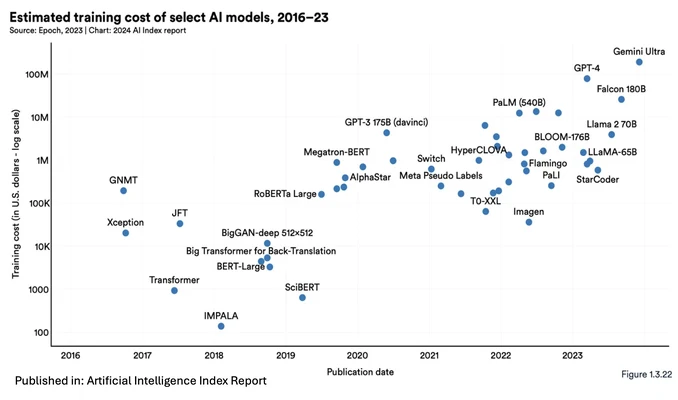
This trend pushes the prospect of cutting-edge model development out of reach for most businesses and countries, consolidating control of best-in-class AI systems in the hands of a few large entities. To avert a homogenous AI future stripped of thought and value diversity, it's critical to champion the continued growth of the open-source ecosystem. Open-source models like Llama, Mistral, and Falcon empower governments, communities, and businesses to affordably fine-tune the base model to their specific values and needs, ensuring that the future of AI is shaped by a multitude of languages and voices.
Confronting AI Bias: Beyond the Illusion of Neutrality
However, a future where the AI model ecosystem fragments into distinct segments—each tailored by country, business, group, or community using cutting-edge open-source technology—isn't the endgame. It is merely the prelude to further personalization, which will be crucial for anyone aiming to serve a heterogeneous user base.
Consider the uproar over Google's Gemini launch this past February. Google was forced to pull the plug on its image generation feature and apologized to India over the tool's characterization of Prime Minister Modi. Sure, Google can—and should—strive for more accurate historical images of, say, America’s founding fathers.
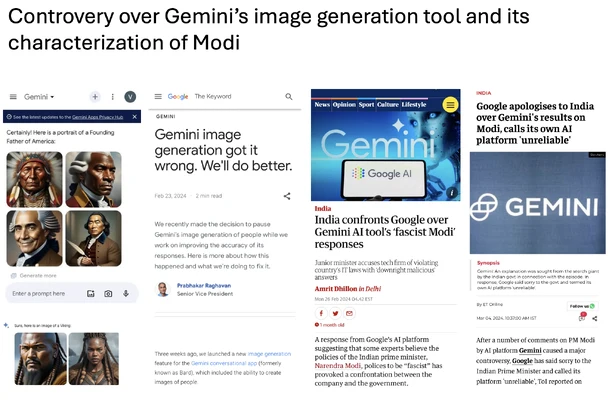
However, much of the criticism and even Google's own mea culpa seemed to miss a crucial point. They imply the possibility of a perfect, unbiased AI system that doesn't step on any toes. But is such a thing even possible? Let’s face reality: No AI can ever be completely unbiased or perfectly accurate. Given that human values and morals vary so widely, biases and judgments of right and wrong are inevitably a personal affair.
AI Personalization and The Accountability Dilemma
This presents a formidable challenge for tech giants like Google, Microsoft, META, and OpenAI, as well as anyone aiming to harness AI to serve a global customer base. These companies cannot afford to cater only to a segment of the political or value spectrum. Historically, platforms like Google and META could offer a wide range of content for users to select from. Users proactively curated their digital environment, choosing friends, influencers, and content that resonated with their personal values and interests, crafting a digital experience closely aligned with their worldview. However, today's AI systems are expected to deliver the ‘one correct answer,’ as if they were contestants on a cosmic game show judged by the entire internet.
The solution? Customizing AI tools and their output for each individual. For example, by learning their unique preferences and then incorporating this data via RAG—a method that allows AI to dynamically retrieve relevant information—into tailored system prompts for a more individualized interaction.
Personalization is Google and META's home turf; they've been playing this game for a while. Companies like OpenAI will have to pick up these capabilities quickly, and the recent introduction of its memory feature, which learns between chats and remembers preferences, addresses that exactly.

Tailoring AI systems to individual users not only broadens their appeal across diverse cultural landscapes but also significantly amplifies their utility. As we edge closer to developing autonomous agent systems, the ability of AI tools to discern and adapt to user preferences without explicit user guidance along each step will become increasingly valuable and, hence, a business necessity. Picture an AI agent expertly curating and booking your next vacation, for example—it's the personalized systems, armed with insights about your taste, preferences, and needs, that will effortlessly eclipse the generic ones.
While it's clear that personalizing AI tools is on the horizon, a pivotal question looms: Will this personalization occur quietly in the background, or will it necessitate active user engagement? Although seamless, unobtrusive personalization is appealing and will undoubtedly play a significant role, I foresee a scenario where companies will also prompt consumers to make explicit choices about the AI tools they employ. The rationale is straightforward: businesses want to shift responsibility for controversial AI outputs onto users to sidestep negative publicity, legal troubles, and the potential for governmental scrutiny. Therefore, the approach to embedding values and personalizing AI will extend beyond mere algorithmic adjustments; it will become a crucial aspect of product management and user interface design.
Inevitable Trade-offs: The Price of Personalizing AI
As we navigate the evolving landscape of AI, the fragmentation and personalization of these technologies are not just inevitable—they're essential. Yet, they bring with them a series of trade-offs that will spark intense debates.
On one hand, open-sourcing powerful foundation models democratizes access, preventing oligopolistic control by a few corporate giants and governments. On the other hand, this openness might risk empowering malevolent actors. Currently, the benefits of this openness clearly outweigh the dangers, but it's a balance that demands continuous scrutiny.
There is also a balancing act between encouraging diverse expressions through a varied model ecosystem and the pitfalls of misinformation and groupthink. Although my own inclination is to champion the preservation of diverse thoughts and free expression, especially when the lines are blurry, the decision on where to draw the line should be thoughtfully considered by each nation and its people.
Equally contentious is the tug-of-war between personalization's allure and the looming threat to consumer privacy. As AI personalization deepens, so does the potential for misuse of personal data, posing a serious dilemma about the extent of necessary regulation. GDPR, the European Union's attempt to protect privacy, had well-intended goals but stumbled in practice, offering valuable lessons for shaping smarter, more flexible privacy rules in the future.
As AI models become more diverse and personalized, we must brace for a resurgence of these debates. It's crucial to look beyond the sensational headlines and focus on voices that recognize these intricate trade-offs, striving to strike a balance that respects both innovation and ethical considerations.
Forging the Future: Embracing a New Era of Diverse and Personalized AI
As we shift away from generic AI systems to those that adapt to individual needs, we're not just acknowledging human diversity; we're making AI work harder for each of us. This isn't just a lofty goal; it's smart business. Companies that get it right will lead the pack. Governments aren't off the hook either; they need to be quick on their feet, updating policies to keep innovation on track without getting tangled up in red tape.
As we march toward this new reality, the path will certainly not be dull. The debates will be fiery, the challenges formidable, and the opportunities immense. This push towards AI that recognizes each person's distinct needs is how we'll build a tech future as varied as humanity itself.
This article was originally published on LinkedIn.