Right now an AI agent is recommending a product to someone who will never see a traditional ad for it. Every day, millions of purchase decisions are shaped by AI assistants that parse data and act in the background. Yet, marketers remain largely focused on how AI is transforming human-facing campaign creation and delivery. That is only half the story. The brands that win will master two revolutions at once.
Two Revolutions, Two Audiences
The human-centric revolution uses AI to perfect today’s advertising model. Create faster and cheaper. Target smarter. Buy and measure better, and optimize continuously. It spans everything from TV to programmatic digital buys, all united by one goal: capturing human attention to persuade.
The machine-centric revolution designs for AI systems that evaluate options and increasingly make decisions for consumers and businesses. Here the primary audience is not a person; it is an algorithm acting on their behalf.
Both revolutions rely on AI agents. The difference is the audience. The first uses marketing AI agents to improve advertising to people. The second influences agents directly. These are not sequential phases. They are unfolding together, and winners will excel at both.
Revolution One: Perfecting Advertising to People
The Campaign Lifecycle, Reinvented
AI is transforming the entire advertising lifecycle. Machine learning has quietly optimized targeting and bidding for years; now generative AI has unleashed a creative revolution too.
Creative assets that once required teams working for weeks can now be produced in minutes. Unilever already uses generative AI to create hundreds of ad variations for its beauty brands, dramatically reducing production time. This signals a future where AI automatically generates and tests countless personalized variations in real time.
AI is also reinventing audience discovery. The collapse of third-party cookies and Apple’s privacy overhaul forced a reset. Now AI systems analyze first-party data, contextual signals, and behavioral patterns to predict and stoke intent rather than simply follow users across the web. The result is hyperpersonalization at scale.
Perhaps most dramatically, AI is tackling advertising’s oldest challenge: measurement. Probabilistic models now estimate true incrementality and ROI more reliably, then move spend toward what works and kill what does not. Systems run around the clock. Campaigns evolve instead of relaunching in bursts.
Humans in the Loop, For Now
This raises a fundamental question: what role will humans play as AI becomes more capable? Today there is deep cooperation across the lifecycle. Systems create, target, buy, measure, and optimize, while people provide strategy, creativity, judgment, and final decisions. Yet the direction is clear. Automation will move from single tasks to whole workflows, then to end-to-end orchestration.
Google Performance Max and Meta Advantage+ already deliver parts of this vision. As Mark Zuckerberg said on Meta’s Q1 earnings call:
“Our goal is to make it so that any business can basically tell us what objective they're trying to achieve … and how much they're willing to pay for each result, and then we just do the rest.”
This future, where ad spend behaves like a direct cost of goods sold, will arrive first for SMEs and for app and ecommerce advertisers with straightforward performance goals. Large advertisers in categories like FMCG will keep humans in the loop longer to exercise tighter control and manage complexity. Still, the trajectory is evident: humans will set parameters and review outcomes while AI agents handle the rest.
This shift will be terrifying and liberating at once, eliminating many traditional roles while making sophisticated advertising accessible to any business. And while we grapple with the impact of AI on advertising TO humans, a second revolution is emerging; one where we must “advertise” to AI itself.
Revolution Two: The Rise of Machine Audiences
While much of the industry’s buzz focuses on Revolution One and its impact on the people creating and executing campaigns, Revolution Two is quietly emerging through fundamental changes in how information gets discovered.
From Links & Clicks to Citations & Inclusion
For over two decades, search and SEO were the cornerstone of digital visibility. That era is fading, and what is replacing it offers the first clear view of the machine-centric future. Instead of ten blue links, AI-powered answer engines such as Google’s AI Overviews, ChatGPT, and Perplexity now return direct, synthesized answers.
Enter Generative Engine Optimization (GEO). While SEO focuses on ranking high in a list, GEO aims for inclusion and citation in AI-generated answers. The rules of optimization are different. While modern SEO already uses structured data and natural language, it optimizes for human discovery, especially human clicks. GEO optimizes for AI inclusion and citation even when no click occurs.
Consider a concrete example: When someone asks "What's the best CRM for small businesses", the AI doesn't simply rely on Google rankings. It synthesizes its training data and live web sources. Forward-thinking companies are adapting their content strategies to ensure their products appear in these AI-generated recommendations. This means structured machine-parseable data, verifiable facts and consistent sourcing, authority and freshness signals, and citation-worthiness over click-worthiness. Not content to be found, but content to be quoted.
This is machine-centric marketing in its infancy, and it is also the foundation for what comes next. The same practices that win GEO today will matter even more when AI agents, not humans, are the primary decision-makers.
When Machines Become Buyers
The logical endpoint of this evolution is clear. AI agents will not just help users search and evaluate; they will also make purchase decisions. Imagine an assistant that knows your household needs, budget, and preferences. It negotiates with seller agents, compares options across thousands of vendors, checks delivery windows, and buys what you need.
In that world, marketing becomes a conversation between systems. You are not crafting emotional narratives for people. You are influencing algorithmic decision-making. This could even involve new economic models, like offering incentives for citations or paying a cut for transactions, much like affiliate marketing.
Aravind Srinivas, founder of Perplexity, envisions marketplaces where
"The user never sees an ad … the merchants are not competing for the user’s attention; they are competing for the agent’s attention.”
So will we live in a world entirely driven by machine-to-machine marketing? No. Critical barriers remain. Prompt-injection vulnerabilities let bad actors manipulate agents. Platform giants like Amazon resist open access to protect their moats, instead building their own agents within walled gardens. And there is the fundamental trust problem: if agents receive compensation for recommendations, how can users trust their objectivity? Yet with billions being poured into agent development, these challenges seem surmountable.
The deeper truth is that humans will not delegate all decisions to agents, even if they could.
The Trifurcated Future
According to Omnisend, 66 percent of US consumers would not allow AI tools to make purchases on their behalf. This reveals a crucial insight: we define ourselves through consumption choices. Humans will likely delegate routine purchases to agents while remaining involved in emotionally significant decisions like fashion, cars, and experiences.
This reality will force a "trifurcation" of advertising strategy:
1. Human-Facing Advertising
This continues focusing on emotional brand building; the storytelling that ensures consumers say "Find me Nike running shoes," not just "running shoes." Brands must also influence whether consumers consider their category worth staying involved in at all, and ensure they're top-of-mind when consumers customize their agents. This advertising will appear in traditional channels like TV and social media.
2. Machine-Facing Advertising
This new discipline is technical and data-centric: structured information optimized for algorithmic consumption. Think product feeds, knowledge graphs, schema markup, API integrations, comparison data, plus the commission structures mentioned earlier. Brands will try to pay for algorithmic preference just as they pay for shelf space, creating the trust and user-experience tensions we flagged earlier.
3. Human-Machine Interaction
This optimizes the human-AI interplay. Recently, I was shopping for a new car seat for my daughter. After seeing an ad for Cybex's new car seat with integrated airbag, I asked an AI agent to research the seat and evaluate top alternatives. The agent, knowing my location, car model, and budget, replied: "The Cybex Anoris could be excellent for you, and here are three alternatives that might also work well..."
The brands that win here excel at both emotional resonance and technical integration. They make me want the Cybex with its innovative technology while ensuring their products appear in AI comparisons with compelling data points.
Across all these touchpoints, brands will increasingly deploy agents that truly embody their values. Not just service bots, but sophisticated representatives that convey every facet of the brand through every interaction, whether engaging humans with authentic brand voice or influencing machines through compelling data.
The Marketing Funnel Remapped
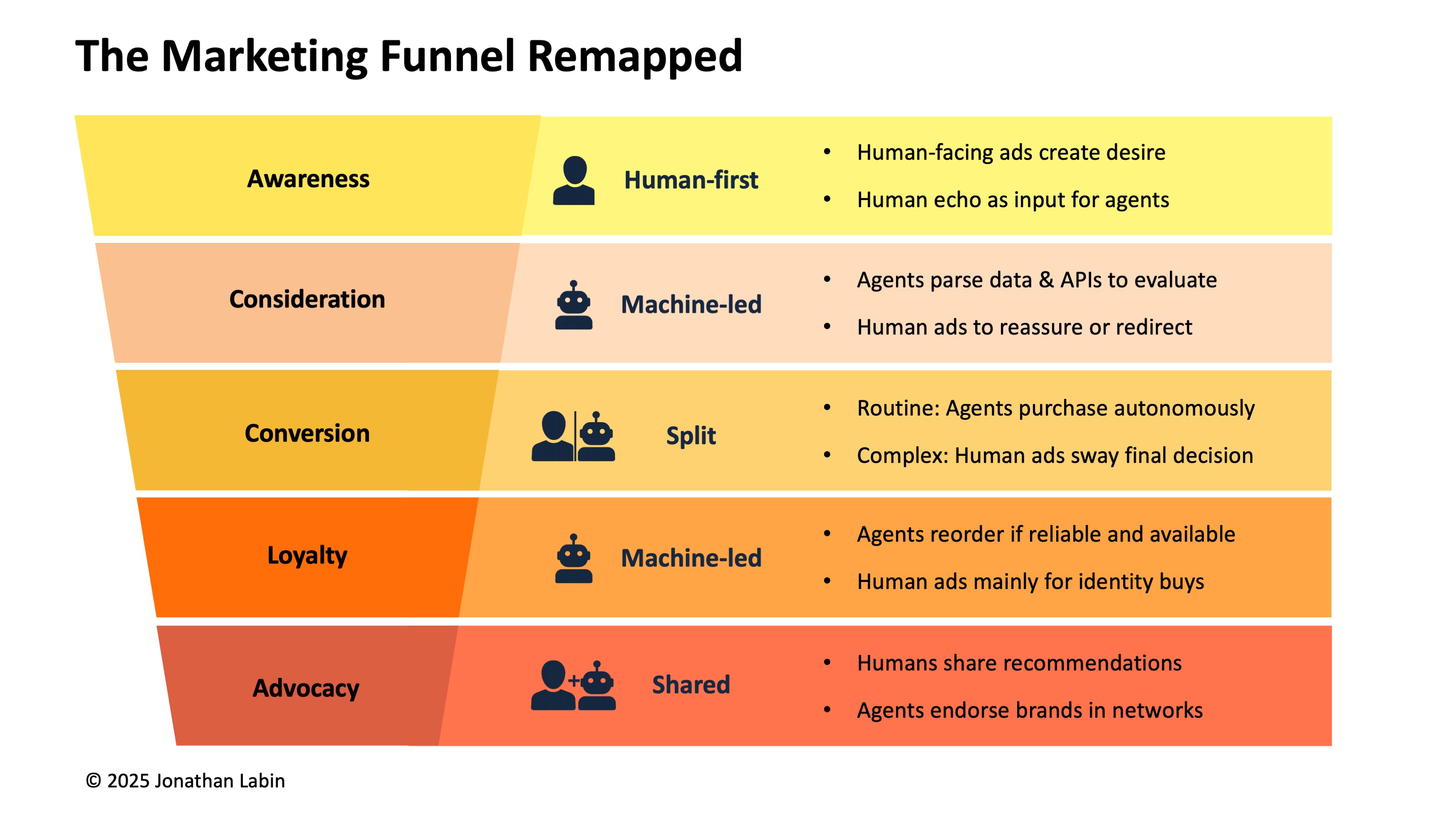
As these strategies take shape, the traditional marketing funnel is being fundamentally transformed. The path from awareness to advocacy is fracturing into a complex, hybrid journey where success depends on mastering the interplay and handoff between human emotion and machine logic.
Awareness: Human Imperative and Machine Echo
At the top of the funnel, the goal remains unchanged: create desire. This stage continues to be dominated by advertising to humans. Platforms like Instagram, TikTok, and YouTube that command scarce human attention will become even more critical arenas for the cultural storytelling that makes a consumer ask for a brand by name.
Yet even here, marketing to machine audiences plays a role. The digital exhaust from human-facing campaigns, such as social media mentions, becomes training data for AI agents. And increasingly, personal AI assistants might proactively shape awareness by surfacing needs before users even recognize them.
Consideration: Rise of the Machine Gatekeeper
The consideration phase is where the baton passes from human to machine audiences.
While human attention remains scarce, machine attention is limited only by compute. The AI agent executes a logical, dispassionate evaluation. It does not see your beautiful ad; it parses your structured data, compares safety ratings via API calls, weighs features from your product feed, and synthesizes thousands of reviews into statistical summaries. Brands that win AI recommendations aren't those with the cleverest tagline, but those with the most complete, persuasive machine-readable data.
Still, this creates a surprising opening for human audiences that is often overlooked. Because answer engines keep users on their platforms rather than sending them away like traditional search, they can surface human-facing ads alongside AI recommendations, providing a powerful new chance to influence consumers at the critical moment of evaluation.
Conversion: A Bifurcated Endgame
At conversion, the path splits. For routine purchases, AI agents operating on preset parameters move straight from trigger to autonomous purchase. Here, machine-audience work is everything. Conversion is won through API integrations and consistently ranking highest on algorithmic criteria.
For high-consideration purchases, however, humans re-enter for the final decision. The agent presents its shortlist of recommended options. At this crucial moment, advertising to human audiences can play the decisive tie-breaker role. A timely offer or powerful brand story can provide the final nudge, persuading a consumer to choose one machine-approved option over another.
Loyalty and Advocacy: From Defaults to Endorsements
In loyalty, marketing tilts toward machines. For routine goods, agents set defaults and reorder once they have enough reliable signals. Higher-consideration items may start with human choice but often default to the same brand at replacement. Take baby formula: the first purchase may be a careful decision, but if parents are satisfied, their agent keeps reordering. Exceptions are categories where shopping is tied to identity or enjoyment, or when dissatisfaction pulls humans back into the loop.
Advocacy plays out on both fronts. Humans spread it through endorsements and word of mouth. Machines spread it too, surfacing brands in comparisons, and recommending them across networks. Loyalty is increasingly machine-led; advocacy is shared.
When the Funnel Collapses
The funnel is not always linear; it can collapse entirely. On TikTok, algorithms might surface the perfect product at the perfect moment. In a single scroll, users discover a brand, check comments for social proof, and impulse buy. Awareness to conversion in minutes.
Embracing the Twin Revolutions
Picture two marketers, one year from now.
The first sits in a meeting, presenting award-winning campaigns built on emotional storytelling, exactly what great advertising should do. The metrics look good: brand lift, engagement, sentiment. Meanwhile, market share evaporates. She does not know that AI agents consistently recommend competitors who invested in machine-readable content. Her campaigns win hearts while algorithms send wallets elsewhere.
The second marketer runs parallel strategies. For human audiences, her AI-powered campaigns generate thousands of personalized variations, optimize spend 24/7, and build desire at scale. For machine audiences, her infrastructure ensures that when customers ask AI for recommendations, her brand appears. She has mastered the new funnel: capturing human attention, winning the algorithm's consideration, and enabling both human and machine conversions.
Which marketer will you be?
This article was originally published by Inc. Arabia.