The other day, my wife walked into the kitchen and found me pacing, speaking in a low, measured voice. “I’m disappointed,” I was saying. “That’s the same mistake as last time.” She waited until I finished, then asked who the poor guy was. “My agent,” I said. “He flagged something as urgent that wasn’t, again.”
This is the same AI agent that sorts my inbox, drafts my replies, handles customer service requests and updates my website. Recently he also cancelled a bunch of subscriptions I wasn’t using, and suggested and then bought a present for an upcoming kids’ birthday party. His name is Yoshi, after our dog Yoshihiro, and I now spend much of the day wandering around the house handing him tasks and giving him notes on how he did.
Describe that routine to anyone outside the tech bubble, and they would assume I was joking, but it is clearly where things are headed. Personal AI agents like Muse, Instinct and others will handle more and more of our lives. They will remind, cancel, book, compare, monitor, negotiate, buy, and increasingly decide. Yet most commentary on this trend gets one thing wrong. It reads like a scoreboard of what agents can and cannot do, and assumes we want to delegate as much as possible. We don’t.
Two questions, not one
Alexandr Wang, Meta’s chief AI officer, made the same point in his pitch to Mark Zuckerberg before joining: a life divides into things we have to do and things we want to do. Build the agent that takes the first kind, he argued, and you free people for the second.
His split adds a second question to the one everyone asks. Together, they decide what we hand to agents:
- Can an agent do it well?
- Do you want to do it yourself?
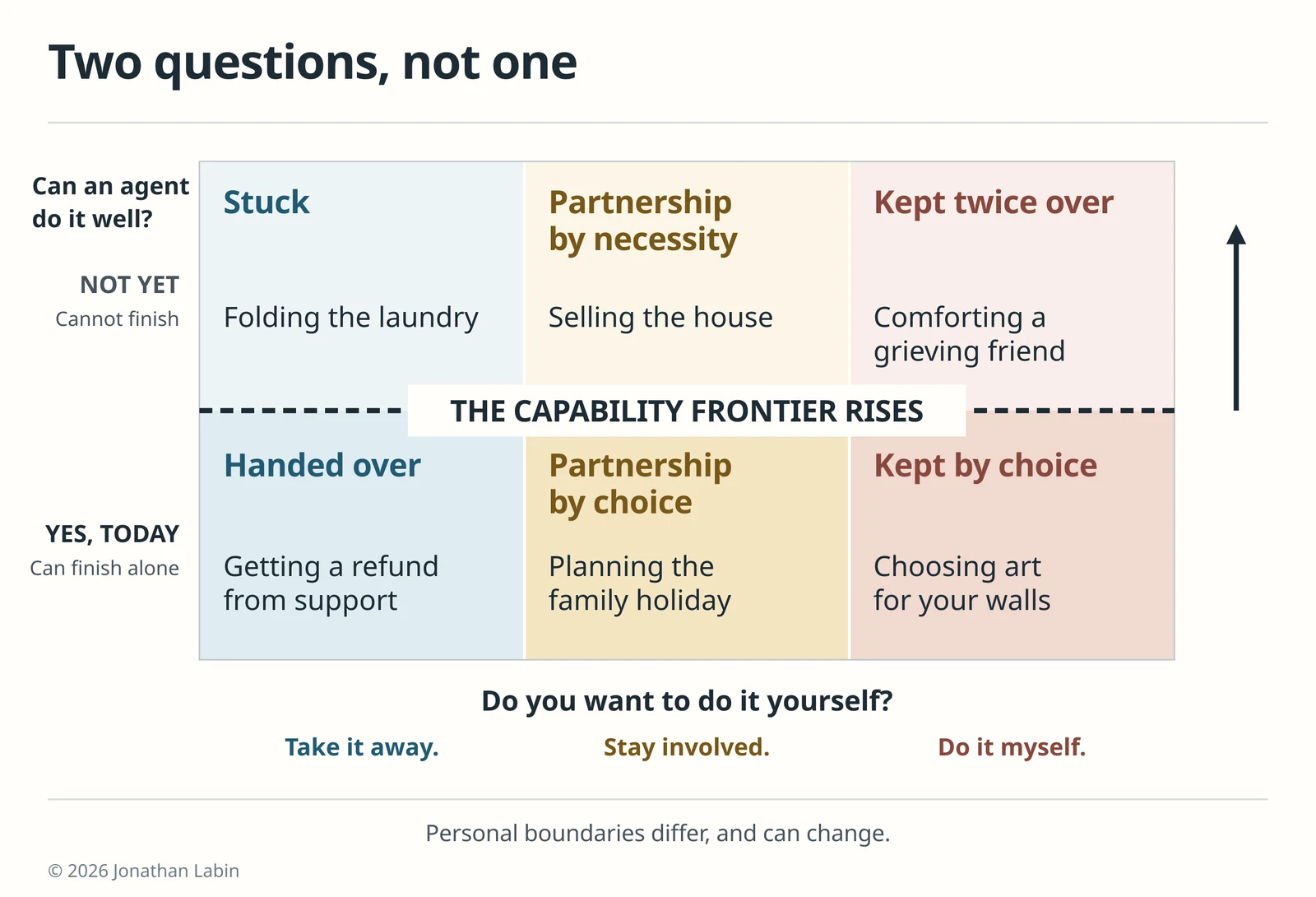
For now, the first question matters a lot. Personal agents still fail often: Yoshi gets stuck halfway through a task more often than I would like. When he does, it is typically for one of three reasons. First, the technology is not ready: the agent is not good enough, or the service it needs is not set up for agents yet; both change by the month, and businesses will make their services agent-ready the way they once, grudgingly, built websites. Second, the agent is blocked: the sceptics’ favourite example is Amazon, which keeps other companies’ agents out. I expect that to change too, once the incentives line up. Third, the task is physical, and atoms are a lot harder than bits: humanoid robots won’t be folding laundry in every hallway anytime soon, but robotics will get there too, eventually.
As these barriers fall, the frontier of what agents can do keeps rising, and the first question matters less and less. Delegation, which used to be a luxury reserved for people with personal assistants, private bankers and a concierge on call, becomes available to everyone.
The frontier of what agents can do is becoming much the same for everyone. The answer to what we want to do is not. It is deeply personal, but it tends to fall into three zones. We hand over routine chores gladly. Others we share, in a partnership where we stay involved. And some we keep entirely to ourselves, the expressive ones, tied to our identity. Where you draw those lines is your own: building a playlist is a chore for one person and a craft for the next. As agents get better, what we hand over grows, what we share becomes a choice, and what we keep becomes worth more.
What we hand over still needs us
Everything we would happily give away ends up handed over: the cancelled subscription, the refund from support, and eventually the laundry too. That sounds like the easy part. It is not. When everyone gets an assistant, everyone becomes a manager.
Delegation does not abolish the human role. It promotes it, into a job most of us never applied for: writing the brief, setting the defaults, checking the output, handling the exceptions, settling the disputes when my agent and yours disagree. The scene in my kitchen was not a joke. It was a performance review.
Management was a job a minority held and the rest of us complained about. It is about to become the universal human skill, and like all universal skills it will stratify: good supervisors and bad ones, people who can specify what they want and people who cannot. The best of them will not mainly check outputs. They will design the world the agent works in: what it knows about them, what it can reach, what it may do alone, what it must escalate, and how much damage a mistake can do before a human sees it. Yoshi may cancel any subscription on his own; anything that costs money, he asks first.
The job is also harder than it looks, because the judgment it demands is the one delegation erodes. Automate the routine work, Lisanne Bainbridge wrote in 1983, and you leave the manager of the system with the hardest residue, the rare and novel cases, while their skills quietly decay from disuse. The signature failure of the agent era will not be the daily error but the exceptional case, handed back at the worst moment to a person who has not made a real decision in that domain for years. The worst accidents will happen at the handover.
And when a handover does go wrong, one thing stays with you. You can hand over a task; you cannot hand over being answerable for it. When your agent books the wrong flight, spends badly or gives offence, “my agent did it” will not be accepted as a defence, and nor should it be.
From necessity to choice
Today, many partnerships are partnerships by necessity. An agent can shortlist schools or price a house, but it cannot finish the job alone, so we stay in because we have to. As the frontier rises, those tasks become partnerships by choice: the agent could finish, and we stay in anyway.
Why stay in, once we no longer have to? For the big decisions, because we live with the result, and we answer for it. An agent can rank every school in the city; it is still our child who walks through the gate. An agent can run the sale of the house; we are the ones who move. Staying in on decisions like these has a side benefit too: it keeps alive the judgment that quietly decays in everything we hand over completely.
For the smaller ones, it is something else: we simply enjoy being there. We plan the family holiday with our agent, who digs up options and handles the legwork, while we keep the part that makes it ours, even when the agent would choose well by every measurable standard. Half the fun of a holiday is the anticipation, and the planning is where the anticipation lives.
This is where the people building agents will most often get it wrong, because it runs against their instincts. For chores, the best agent does the most. In a partnership, the best agent knows what to leave alone: it presents you with three holidays you can already picture yourself in, and then leaves the choosing to you.
That shortlist also exposes the condition everything in this essay rests on: the agent has to work for us. Whoever picks the three has already shaped the choice, and if someone quietly paid for a place on that list, the agent is working for them, not for us.
What stays ours
Some things we keep because they are ours: what to wear, what to hang on our walls. An agent could choose, and by some measure choose better. But a choice made for you says much less about you. Other things we keep because the doing is the point. Nobody wants an agent to finish their crossword. And some things we would keep twice over: saying the words at a funeral, comforting a grieving friend. Agents cannot do them well today, and we would not hand them over if they could.
The more of life that can be delegated, the more the undelegated is worth. An agent can send the flowers, book the flight to the funeral and help me draft what to say. It cannot stand up and say it, or sit with a grieving friend in the middle of the night, and if it could, that would miss the point. What my being there carries is not the help. It is the evidence that I chose not to delegate, that I chose to come. Presence and touch do not get cheaper as everything else does. They only get dearer.
The visit instead of the call, the call instead of the message: each will carry more meaning precisely because it was optional.
Alongside our taste, our pleasures and our attention to each other, one more thing stays ours, the one with the most room to grow: our ambitions.
The want-to-do world
Explaining why Meta built Muse, Wang described an agent that clears the way and solves all the problems it can, until “the human part, the wanting and the dreaming, is all that’s left.” I would go one step further. What is left is not just the wanting and the dreaming, but the doing we choose to keep. That part is bigger than it looks.
In 1930 John Maynard Keynes predicted that within a century, compound growth would largely solve the economic problem, and humanity would face the harder one: what to do with freedom. The wealth he forecast broadly arrived, at least for the societies he was writing about. The fifteen-hour week did not. People whose grandparents could not have imagined their material comfort still work well past fifteen hours a week, want more, want different, want status and meaning and each other. Keynes was not wrong about capacity. He even saw that our wish to feel superior to others might never be satisfied. But he still underestimated wanting. It expands to fill whatever necessity releases.
Agents are the next step in that story: they take on the have-to-do side directly. None of this depends on the post-work utopia that lands next Tuesday, with robots doing the dishes and everyone taking up pottery; for most people on this planet, that stays a fantasy, and most of us will still have to earn a living. But the line between have-to-do and want-to-do already runs through our free time, whether we work a lot, a little or not at all, and agents push it toward the want-to side.
What remains is not an empty calendar but more space for the want-to-do side, which is everything we choose not to hand over. It contains entertainment and pleasure, certainly, and those will do very well out of the agent era. But it also contains more ambitious endeavours: making things, learning things, competing, caring, building a company, raising a child, getting good at something difficult for no reason beyond that it is yours. When less requires your hours, what you do with them says what you are for.
That ambitious half of wanting might not just survive. It might grow, in size and in kind. New possibilities keep raising what counts as enough. Tea and sugar were once luxuries ordinary Britons never had; within a few generations, they were everyday wants, and households worked longer hours to afford them. Historians call this the industrious revolution. Something similar may happen with intelligence. In the pre-agent world, cognition was scarce and acting on it was costly: what we knew, how far we could think a problem through, who we could ask and every phone call and form in the way capped what we attempted. As agents make both cheaper, projects that once demanded more brainpower and legwork than one person could supply come within reach, and with them wants that could not have existed before. Venkatesh Rao calls this a cognitive industrious revolution. If he is right, freed time does not drain into the couch. It flows into bigger ambitions: the opposite of the WALL-E future so many fear.
This essay is a small example. An agent pulled the sources, checked my claims against them, challenged nearly every paragraph and will publish the piece on my website. None of that made the work smaller. I argued with it for days, threw out whole sections and thought harder about this piece than I would have alone. Whether that made it better, you’ll have to tell me.
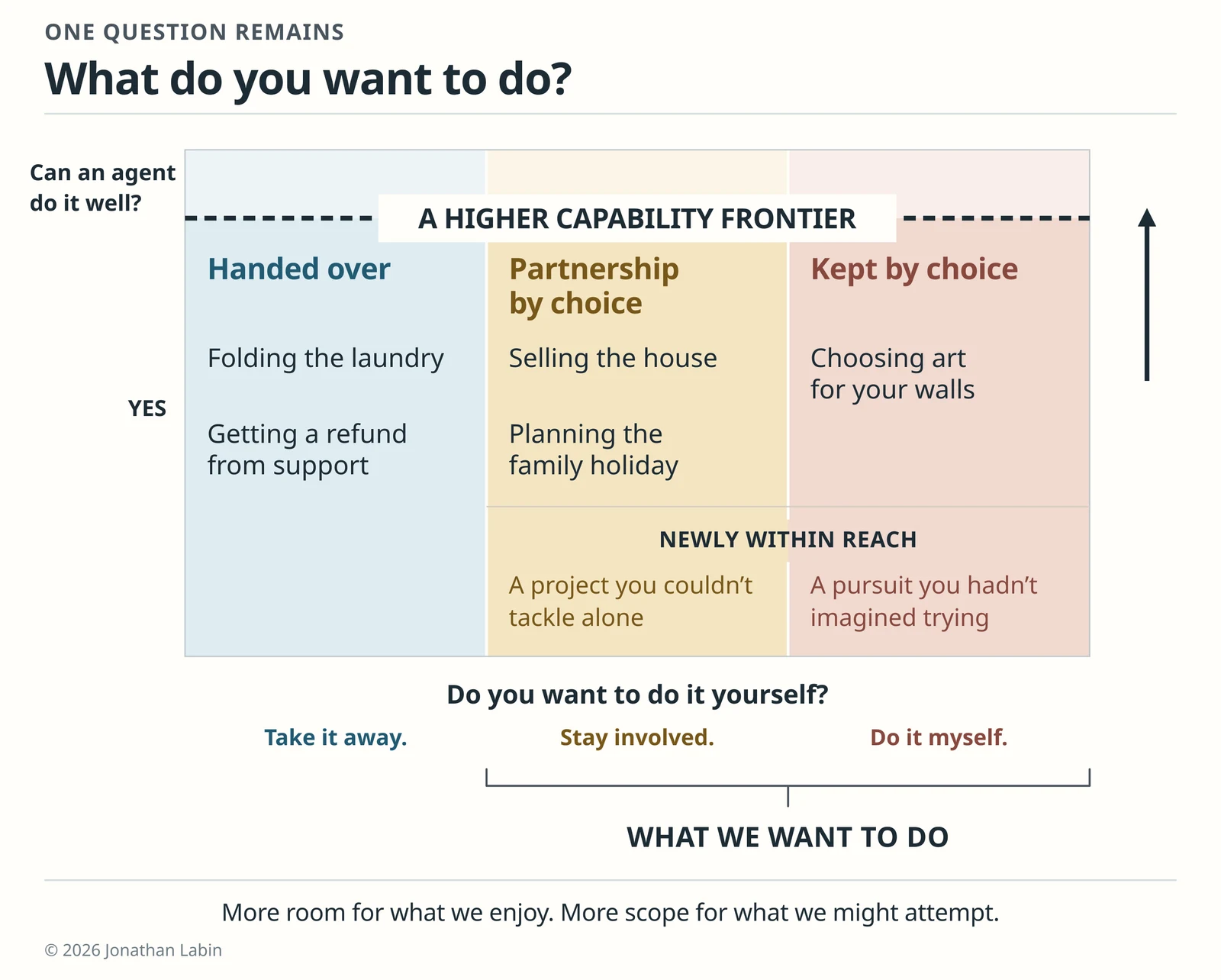
Agents will not deliver that world finished, and they will not deliver it to everyone at once. What they can do, gradually and unevenly, is tilt the balance of a life: fewer hours spent on what has to be done, more spent on what is wanted. I do not find that frightening, and I do not find it utopian. I find it clarifying. Yoshi will get better at his job every year, and the performance reviews in the kitchen will get rarer. The harder job is mine: deciding what I want to do, by myself or with him. The question the agent era puts to each of us is not the one the industry keeps asking, which is what the machines will be able to do.
It is what we will want to do.